

Business Customer Complaints 2025-26

CCW’s annual Business Customer Complaints Report looks at complaints made by non-household customers to water retailers operating in the English retail market and water companies in Wales.
The report highlights a sharp rise in complaints escalated to CCW, despite complaints made directly to retailers remaining broadly stable.
Key findings
- Complaints escalated to CCW rose by 30%, increasing from 1,966 to 2,562 during 2025-26. Complaints brought to CCW are now 211% higher than before the business retail water market opened in April 2017.
- Complaints made directly to retailers increased by just 0.7%, from 20,005 to 20,139, but Stage 2 complaints rose by 15%. This suggests some retailers are not resolving complaints effectively enough at an earlier stage.
- Three-quarters of complaints raised by business customers were linked to retailer-related issues, underlining the need for retailers to resolve problems quickly, communicate clearly and get bills right first time.
- Billing remains the biggest cause of complaints across the market. It accounted for 48% of complaints made directly to retailers and 90% of complaints escalated to CCW. Measured billing disputes remain the largest single issue handled by CCW, accounting for more than half of its casework and increasing by 25% during the year.
- Complaints relating to debt activity rose by 131% and now account for 18% of cases handled by CCW. Complaints about back-billing increased by 307%, reflecting growing pressure on some business customers as retailers step up debt recovery activity.
- Retailer performance continues to vary significantly. Water2Business, Source for Business and ADSM were among the strongest performers, while SES Business Water, Clear Business Water, Castle Water and Water Plus were among those generating the highest levels of complaints relative to their customer base.
- CCW believes the rollout of smart water meters presents an opportunity to improve billing accuracy and reduce disputes. Around 800,000 smart water meters are expected to be installed for business customers over the next five years, but companies need to communicate clearly with customers about installations and the benefits of smart metering.
CCW will use these findings to work with retailers to improve billing accuracy, complaints handling and customer communication. This includes offering complaint assessments to help companies identify opportunities to improve service and reduce customer effort.
Appendices
Exhausted and non-exhausted complaints to CCW
We define a non-exhausted complaint as any complaint that gets raised with CCW by a business customer before all stages of a retailer’s complaints procedure have been exhausted. This could be due to unclear signposting of the complaints procedure, making it difficult for customers to follow; dissatisfaction with how the retailer handled the complaint; or frustration with the level of communication received in response.
We have categorised all complaints received as either complaints (which CCW should handle) or ‘pushbacks’ (where a retailer’s complaints process has not yet been exhausted and the issue should continue to be handled by the retailer in line with its published procedure). There are also a small number of complaints that fall outside of our jurisdiction where we are unable to help. A breakdown of the complaints by handling type is set out below.
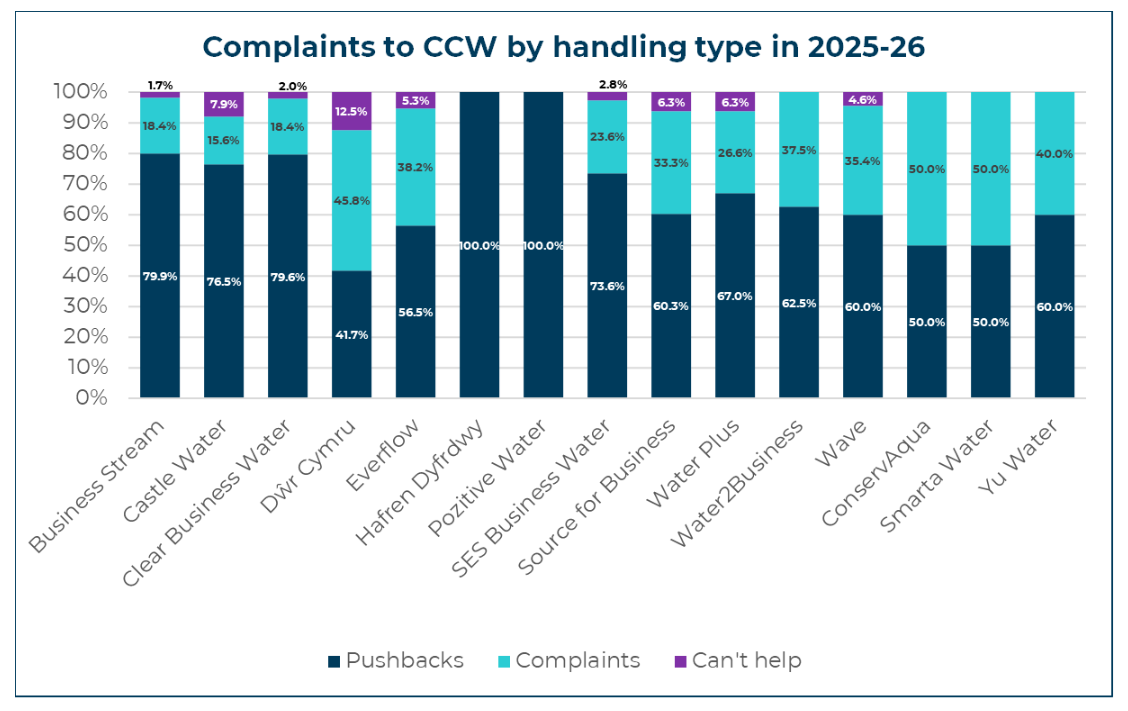
*Due to rounding, numbers may not add up to 100%. ADSM, The Water Retail Company and Veolia received no complaints in 2025-26, Simpli Water, Waterscan and Mitie will be included in next years’ report.
CCW work to drive better customer outcomes in the water retail market complaints assessments
CCW offers a free service to retailers to carry out complaints assessments. During these assessments we visit the retailers and jointly review a selection of recently closed complaints the company has received. We review these against our non-household complaints guidance, alongside a review of internal processes to identify where improvements can be made. Retailers receive a report highlighting both good practice and areas for improvement. Delivery against these actions is monitored by our engagement team.
Due to the competitive nature of the market, the reports are not published and remain confidential between the company and CCW. In 2025-2026 we carried out 2 assessments with retailers. In both cases the retailer reported they found the assessment useful and welcomed CCW’s input. Participation is voluntary, and we encourage more retailers to take part to help drive improvements in customer outcomes.
This year we are extending the approach to include joint assessments involving both wholesalers and retailers. This reflects the fact that many complaints – particularly those relating to metering – span both service elements i.e. wholesaler and retailer. This approach will help identify where the end-to-end customer journey can be improved.
Industry engagement and collaboration
CCW plays an active role in bringing together retailers and wholesalers to address customer issues and improve outcomes across the market.
The ‘One Customer’ Forum, held twice a year, provides a platform for joint discussion of key issues that are driving, or have the potential to drive, poor customer service. These sessions focus on identifying shared challenges, improving collaboration, and ensuring that customer needs are at the centre of decision-making.
At the most recent forum (April 2026), discussions focused on business customer communications around smart metering, billing issues and CCW’s complaints assessments. Research partner, Yonder, presented qualitative findings on the experiences of SME and large business customers, highlighting both strengths and areas for improving the smart meter rollout journey early in the five-year period. CCW also hosts Retailer Forums, which provide a space for retailers to share insights, identify common challenges and explore solutions. These sessions enable CCW to share research findings and challenge areas where service improvements are needed.
Alongside this, CCW contributes to a range of market-wide groups, including MOSL governance and code groups and Retailer-Wholesaler Group (RWG) forums. Through this involvement, we represent the interests of business customers and help drive improvements at a systemic level. Our membership on these groups, as the customer representative, includes the Strategic Panel, Codes Change Committee, Performance Assurance Committee and Metering Committee.
Further information on these can be found on the MOSL website .
Bill design
CCW is leading a working group to support retailers with the design of their customer bills. CCW is not advocating for all bills to appear the same, as that is up to retailers and their individual approach, but rather to ensure that the minimum information required by legislation is adhered to and that this and other information is displayed clearly and is easy to understand for customers. A good practice guide will be agreed by the working group and published on the CCW website. This project is expected to conclude by September 2026.
Third party intermediaries
CCW will be carrying out research into the experiences of Third-Party Intermediaries (TPIs) in the water retail market and the services they offer to business customers. The research will help deliver one of our actions under the Strategic Panel’s Roadmap to a Flourishing Market. As part of our research, we will be talking to TPIs, retailers and customers to find out what they think about how the market currently operates and whether they believe any changes are needed to improve the experience for business customers. We expect to carry out the fieldwork for the research in Autumn 2026 and publish the report by the end of the year.
Joint CCW and Ofwat customer insight research in 2025
In October 2025, CCW published joint business customer insight research with Ofwat. The focus of the research was to understand customers’ market awareness and engagement levels, potential barriers to engagement, and how these could be addressed. The research revealed a significant fall in overall satisfaction with the water industry from 60% in 2020 to just 15% in 2025. However, more business customers were active in 2025 (19%), primarily due to an increase in the number of customers considering whether to engage and those who had tried to switch but couldn’t. There is more to do to increase satisfaction in water, sewerage and retail services and to support businesses that want to navigate the market.
Business customer smart water meter communication research
In 2025, CCW commissioned research to understand how business customers navigate the information and support they receive at each stage of the smart meter journey, from initial communication through to post-installation of the meter. This was published in April 2026. Overall, the research finds that the smart water meter rollout is operationally effective, but its potential benefits are being undermined by unclear communication, inconsistent data access and low engagement after installation. Clearer and better-timed communication – especially about what ‘smart’ means in practice and when data will be available – will be critical to ensuring smart water meters deliver meaningful value for business customers over time. CCW will continue to work closely with water companies and retailers to help ensure customers’ information needs and expectations are met.
See Appendices 3-7 for the data tables to support this report.