

Environment Matters 2025: Insight from Water Matters 2025

Water Matters report – what are the findings telling us?
Our latest annual Water Matters tracking survey was published back in May. As the longest-running in-depth survey of water customers, this research gathers a lot of detail, which is why we have been following up with a series of shorter ‘mini reports’. These each look in greater depth at specific themes from the latest Water Matters data. We have already published ‘mini matters’ summaries on customer contact and affordability.
This summary looks at perceptions of environmental performance, and water customers’ perceptions around what their company is doing to protect the environment. The previous year’s survey saw record low scores across almost all areas related to perceptions of environmental performance. The overall picture this year is one of slight improvement in these areas, though in many cases scores are still low in comparison to earlier years. Table 1, below, shows how satisfaction has shifted in the key environmental-related metrics since last year:
Table 1: Key environmental performance perception questions and changes in score, 2023-24
| Question | 2023 Score | 2024 Score1 | Change in score2 |
|---|---|---|---|
| Satisfaction with what the company is doing to clean waste water before releasing it into the environment | England – 35% Wales – 41% |
England – 38% Wales – 43% |
England + 3% Wales +2% |
| Satisfaction with what the company is doing to minimise sewer flooding | England – 42% Wales – 53% |
England – 46% Wales – 48% |
England +4% Wales -5% |
| Satisfaction with what water companies do to protect the environment | England – 32% Wales – 41% |
England – 34% Wales – 44% |
England +2% Wales +3% |
| Confidence that longer-term water supply will be available without restriction | England – 59% Wales – 70% |
England – 60% Wales – 74% |
England +1% Wales +4% |
The summary below looks at some of the key findings around perceptions of environmental performance and resilience in more detail.
Concerns about pollution remain the key driver of satisfaction with environmental performance
When it comes to perceptions of environmental performance, the key metric in Water Matters is the question measuring satisfaction with ‘what your water company does to protect the environment.’
Last year, this had tumbled to a record low of 32% in England, and 41% in Wales. This year, we saw a slight increase in satisfaction, in both England, up to 34%, and Wales, up to 44%. This is welcome and a step in the right direction, but there is much further still to go, not least as we are still seeing barely a third of customers expressing satisfaction. Moreover, customers are becoming increasingly polarised when it comes to perceptions of environmental performance: as well as a slight increase in satisfied customers, we also saw more dissatisfied customers this year, now making a third (33%) of overall customers across England and Wales for the first time3.
In terms of what is driving these views on companies’ environmental performance, as in previous years, positive views reflect a range of reasons, including:
- They preserve the environment/wildlife (20%)
- The company does all it can (20%)
- Never heard of any problems (18%); and
- Good service (13%)
However, negative views are almost entirely driven by a single issue: 80% of responses mentioned ‘too much sewage/pollution is put into water’.
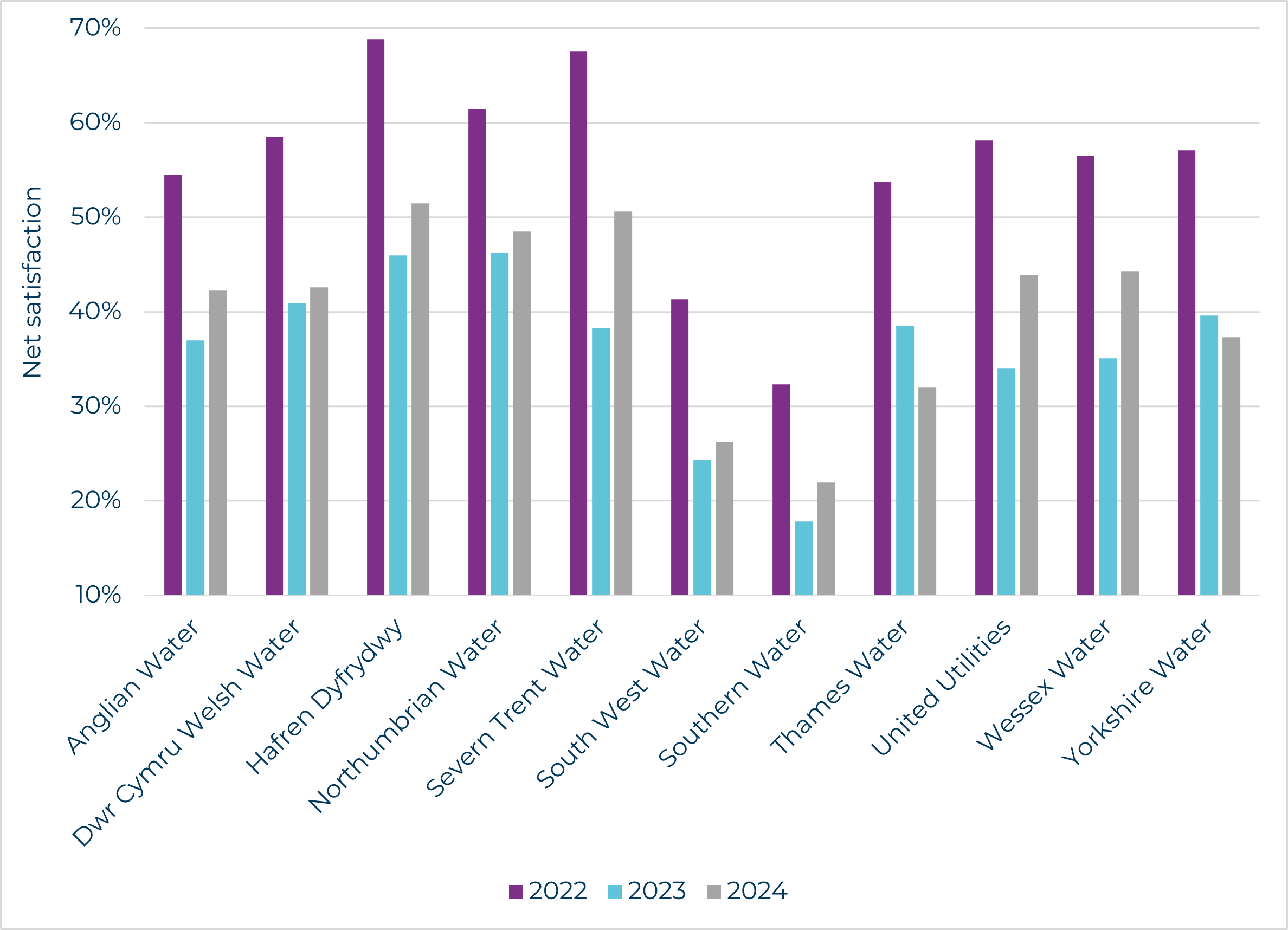
Figure 1, below, shows that satisfaction fell in relation to cleaning waste water for all water and sewerage companies across England and Wales between 2022-23. Of all the different aspects that make up overall satisfaction with sewerage services, ‘cleaning waste water’ is the one where satisfaction scores have shifted the most sharply in recent years, reflecting its central importance to customers. While satisfaction increased in nearly every WaSC (see Figure 1, below) in 2024, the overall score across England and Wales was only 38% – well below the scores for the other components of satisfaction with sewerage services.
Figure 1: Net customer satisfaction with what your company does to clean waste water properly (2022-24)
Impact of perceived environmental performance on company trust
In our analysis of last year’s Water Matters survey, we noted the link between falling trust scores and the increasing lack of confidence in what companies were doing to protect the environment.
Indeed, this is something that our joint Customer Spotlight research with Ofwat highlighted, which showed that less than a quarter (23%) of respondents trusted water providers to do what’s right for the environment, down from 31% in 2021. We will shortly be revisiting this survey, and an important learning will be whether this customer sentiment for this metric has since moved.
Figure 2, below, shows that this year, as before, there is a link between companies with low trust scores and low customer satisfaction around environmental protection.
Figure 2: Net customer satisfaction with company efforts to protect the environment, against trust score
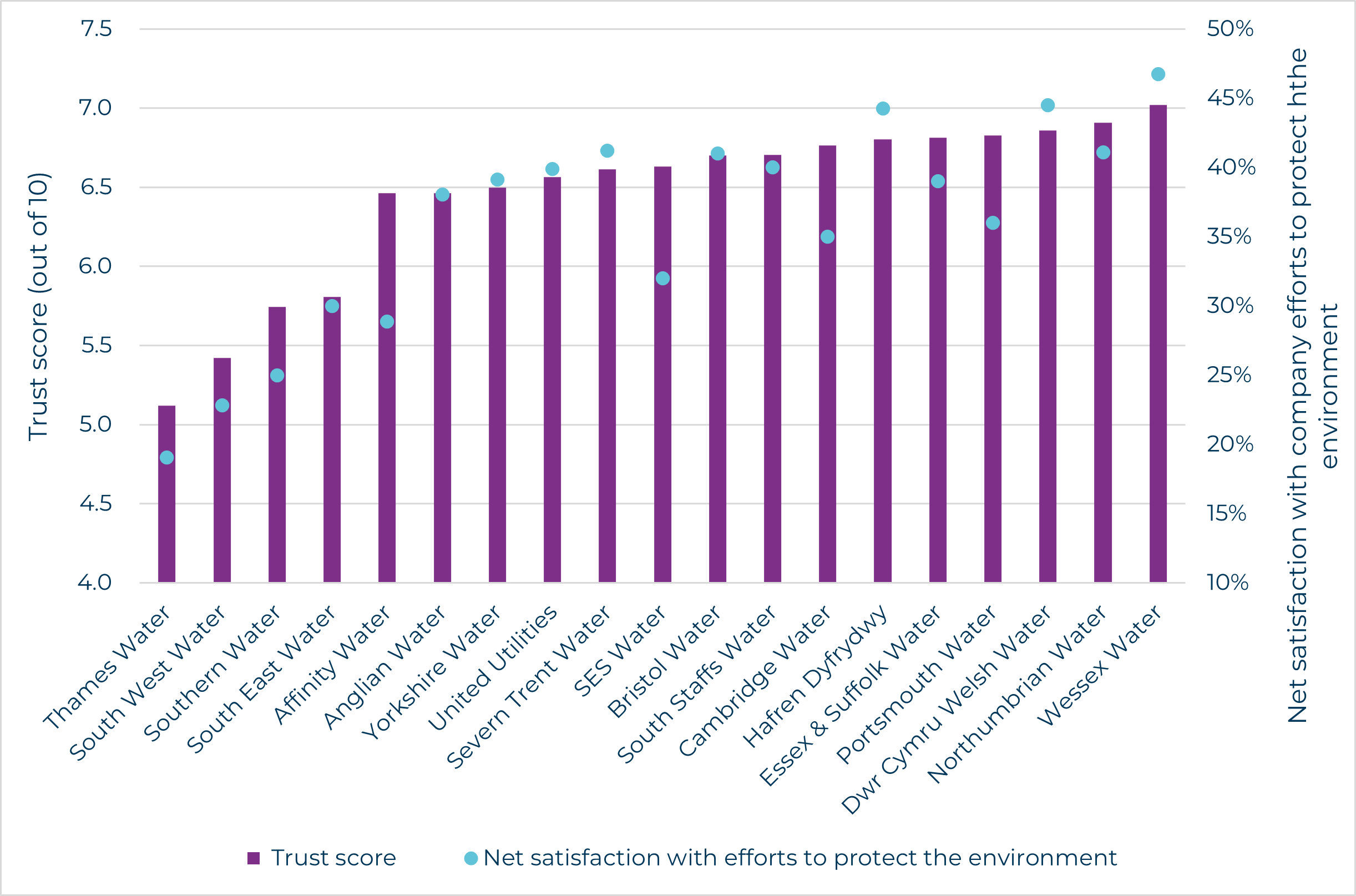
It is true that, overall, across England and Wales this year satisfaction with companies’ efforts to protect the environment rose slightly while trust scores fell; however, at a company level the close relationship between the two scores remains. Indeed, a majority of companies actually saw their trust scores rise this year, including Anglian Water, Severn Trent, Southern Water, Wessex Water, Bristol Water, Cambridge Water, Portsmouth Water, South East Water and South Staffs Water. All of these companies saw their satisfaction scores for environmental protection rise, while the companies with the largest falls in trust (Thames Water and South West Water) saw satisfaction with environmental protection fall further, to 19% and 23% respectively.
We are seeing at a company level that improving customer perceptions around environmental performance is an important part of the wider process of reversing falling trust scores. While there is clearly further to go to return trust levels to where they have been historically, this is a welcome step in the right direction and we will see in the forthcoming Water Matters survey whether this has continued. In the meantime, we want to see companies being open and honest with their customers about current performance, and to share their plans to make improvements in the areas that we know matter to customers.
Long-term confidence in water supply is up slightly
When thinking about the long-term resilience and sustainability of the water sector, one of the more pertinent questions from the Water Matters surveys is a measurement of confidence in long-term availability of water supply.
As is the case across a range of metrics, this has seen a significant fall in previous years; from three quarters of customers in England and Wales in 2020 saying they were confident that, in the long-term, their water supply would be available without restrictions, down to just 59% in last year’s report.
While this year we saw a small increase in England, up from 59% to 60% – and a larger increase in consistently higher-scoring Wales, up from 70% to 74% – as is the case elsewhere across this year’s survey, these increases were not enough to change the fact that the long-term trend for this question is now negative for the first time.
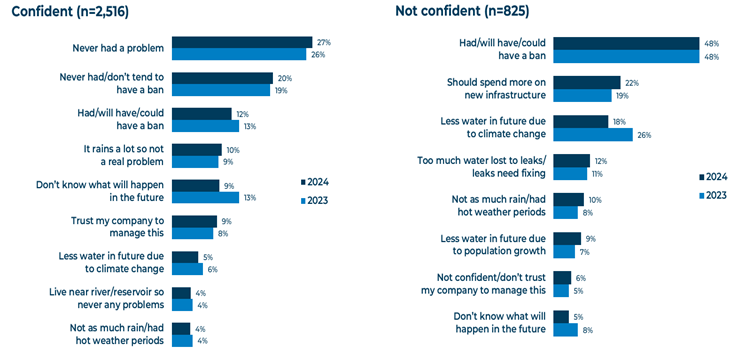
When asked why they were/were not confident, customers gave a range of explanations, as set out in Figure 3, below. While these followed a similar pattern to the reasons given in last year’s survey, it is noticeable that, among those customers who said they were not confident in the long-term supply of their water, there was a significant 8% drop in citing climate change as a reason. Instead, there were slight rises in customers mentioning company responsibilities, such as ‘should spend more on new infrastructure’, ‘leaks need fixing’ and ‘don’t trust my company to manage this.’
We will need to monitor in future Water Matters surveys whether this is an emerging trend, whereby perceptions of poor environmental performance by water companies are leading customers to increasingly think companies – rather than climate change – are a risk to long-term water supply.
Figure 3: Reasons that customers are confident vs. not confident in long-term availability of their water supply, grouped (2023-24)
Conclusion
As in previous years, the latest Water Matters report shows how wider customer satisfaction and trust in their water company is often driven by perceptions of environmental performance. Therefore, water companies need to be open and honest about their current performance and their plans to improve in the areas that clearly matter to their customers.
We have not seen further falls in satisfaction with environmental performance this year, which is welcome – although the increases in score have been mostly minor, and not statistically significant. Moreover, there are concerns that this improvement is a mixed picture: dissatisfaction is on the rise, as well as satisfaction, and company scores vary significantly when it comes to environmental performance.
Pollution concerns continue to be a significant driving force of customer opinion, as our priorities testing research published earlier this year also shows. We will be monitoring these developing trends in the next Water Matters survey, which is due to be published in spring 2026.
1Although published this year (2025), the most recent survey refers to data obtained from fieldwork carried out in 2024, hence why it refers to ‘2024 score’.
2Changes highlighted in red represent statistically significant movement since last year
3The remaining third of responses to this question were neutral (32%)