


Affordability Matters: Insight from Water Matters 2026

Water Matters report – what are the findings telling us?
Our latest annual Water Matters tracking survey was published back in May. As the longest-running in-depth survey of water customers, this research gathers a lot of detail, which is why in recent years we have begun following these up with a series of shorter ‘Mini Matters’ reports. These each look in greater depth at specific themes from the latest Water Matters data.
This summary looks specifically at the data and findings from this year’s report dealing with affordability, an increasingly important topic at a time of rising household water bills. As this summary will explore, affordability is also closely tied up with other significant issues, most notably falling trust.
Agreement that bills are affordable – and fair – is at a record low
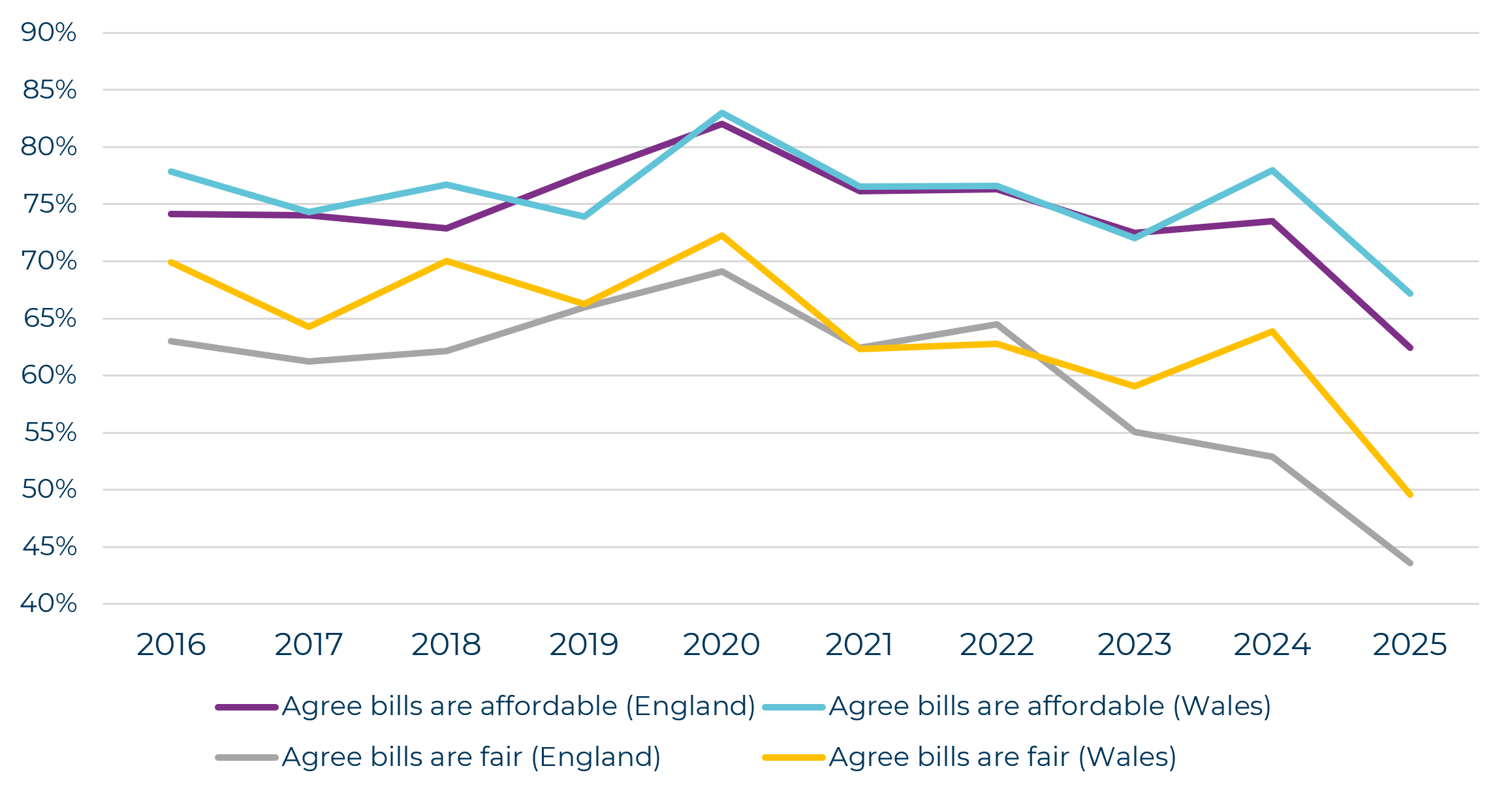
Last year’s Water Matters drew attention to the fact that we had seen a small but nevertheless significant increase in the proportion of customers who agreed that their bill was affordable, up from 72% to 74%. However, we also noted that this fieldwork had taken place before the announcement by water companies of bill rises: it is therefore not surprising that we saw our largest ever fall this year in agreement that bills were affordable, down to 63%.
Of even greater significance, though, was that we saw a 9% fall in the proportion of customers who felt their bill was fair – down to just 44%, the first time ever that fewer than half of customers agreed. As Figure 1, below, shows, throughout every year of Water Matters results people have been more likely to think their water bill is affordable than it is fair.
CCW’s Water Voice panels looked at this in more detail earlier this year, with Spotlight findings (pdf) showing that the perceptions of unfairness are being driven primarily by company profits, the fact that bills are rising faster than household income, and the feeling that they are paying for past under-investment.
This drop in agreement around the fairness of bills also reflects the wider reduction in customer trust, which has been such a large theme of recent Water Matters reports, and was looked at in more detail in our recent Mini Matters summary, has filtered into a stronger feeling around the fairness (or unfairness) of bills.
Certainly it is notable in this year’s Water Matters that customers of the companies with the three lowest trust scores, Southern Water, Thames Water and South West Water, were also the least likely to agree their charges were fair. Rebuilding trust, therefore, will also involve increased, more effective assurance to customers that their bills are being used to deliver value and investment that they can tangibly appreciate.
Fewer customers than ever feel they are getting value for money
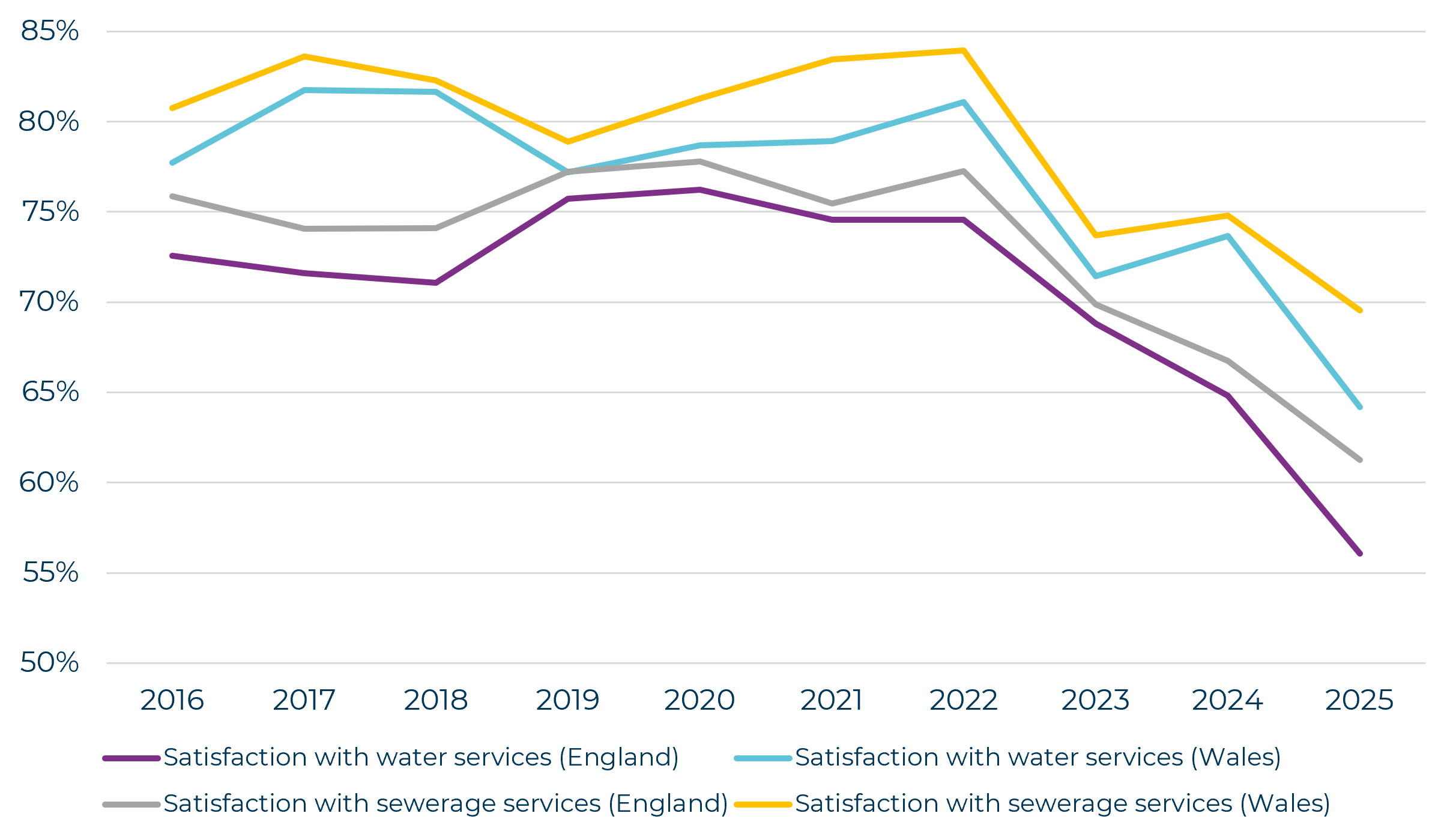
Linked to this issue of fairness of bills is the question of value for money. As Figure 2, below, shows, when it comes to satisfaction with value for money, across both water and sewerage services, the picture is the same as with overall affordability: after a steady increase up to 2022, this has been falling sharply ever since, a trend that has continued this year. This year’s value for money scores were the lowest ever recorded; down to 62% overall for sewerage services and 57% for water services.
While last year there was a significant divergence, in that satisfaction with value for money continued to fall in England but rose in Wales, this year the negative picture was uniform across both countries.
This issue of value for money goes beyond whether or not bills are actually affordable: there is the larger, existential issue that customers feel that rising bills are not leading to the delivery of better outcomes. This echoes the recent summary of trust insights from Water Matters, which looked at the rising trend of customers feeling that their company ‘didn’t care’ about the service it provided, and how this is in turn affecting record low trust scores.
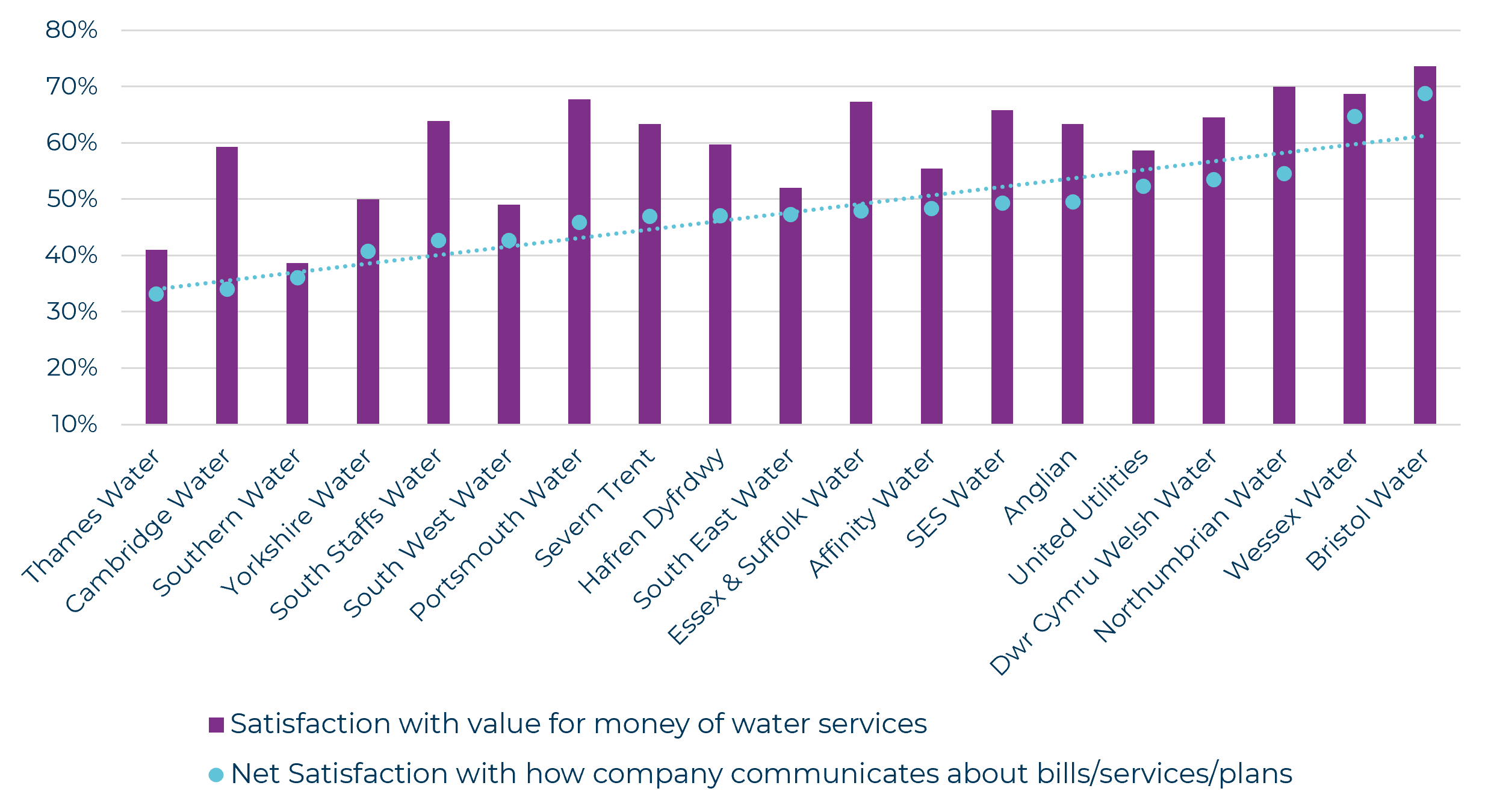
In terms of how falling satisfaction with value for money can be reversed, there is therefore a potential opportunity around improving communication on how rising bills are being spent, and where improvements are being made. It is noticeable, as figure 3 demonstrates, that among those companies with the lowest scores for how well they communicate about bills/services/plans we also see those with the lowest satisfaction with value for money. At the other end, the company with the highest score for communication (Bristol Water) also saw highest satisfaction with value for money – and indeed had increased their value for money score this year, much against the wider trend.
More customers are aware of financial support
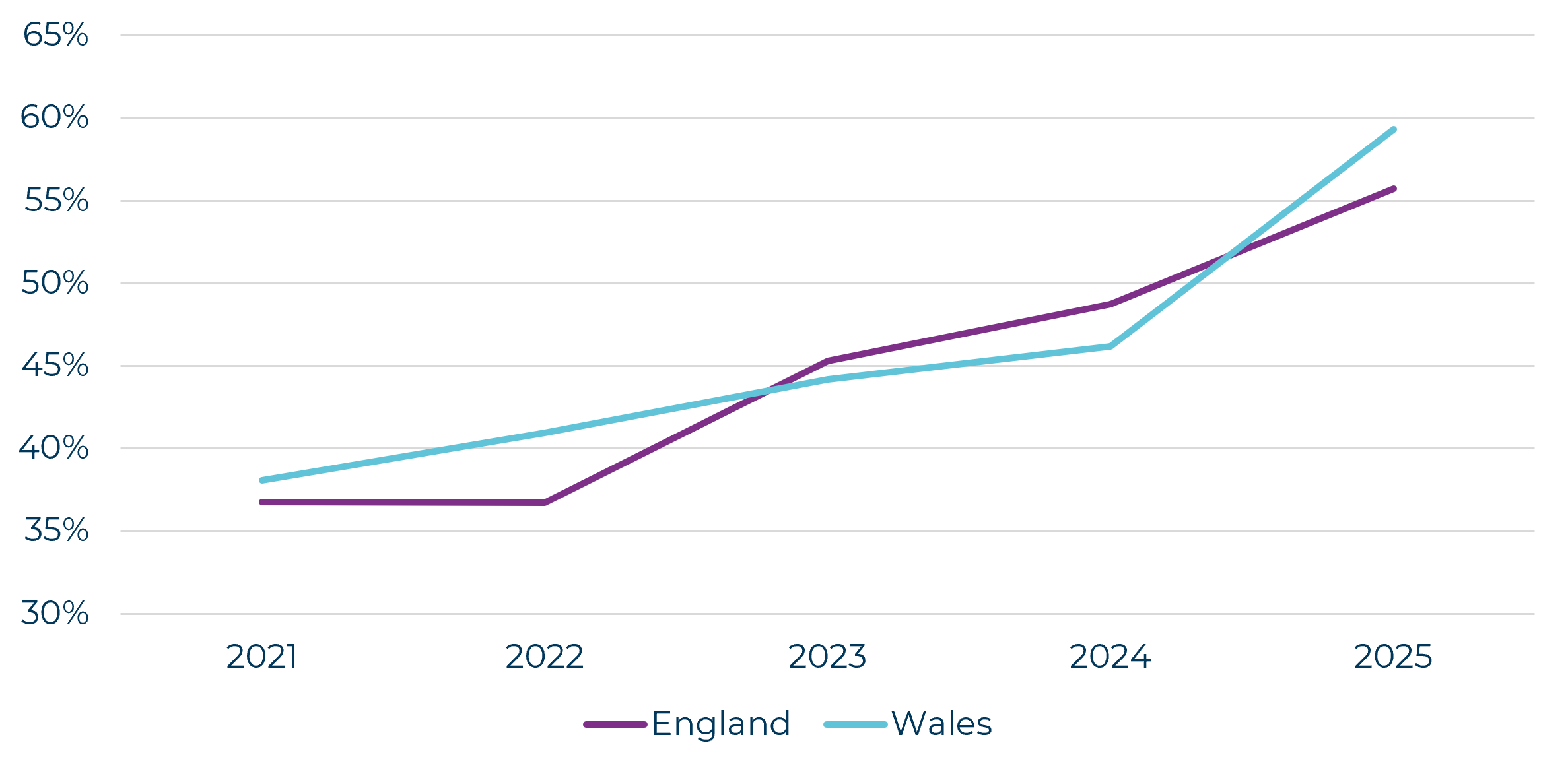
One of the few consistently upward trends across Water Matters in recent years has been around customer awareness of various financial support measures: awareness of WaterSure is up 7% from last year to 25% (for WaterSure Wales, it is 26%). WaterSure is a UK government-backed assistance scheme that caps your annual water and wastewater bills if you have a water meter, receive qualifying benefits, and use high amounts of water due to a medical condition or a large family. Awareness of water companies’ offer of reduced bills for financially struggling customers is now at 56%, another significant increase from last year, and in line with the aim in CCW’s Forward Work Programme to reach 60% awareness overall by the next round of Water Matters.
Figure 4, below, shows how awareness of wider financial support has risen across England and Wales since 2021, when the question was added to our survey. For the last two years, awareness in Wales lagged behind England, but this year saw a significant 13% increase in Wales, overtaking England. This represents a clear upwards trend overall: only three companies (Severn Trent, South Staffs Water and South East Water) did not increase their awareness score from last year, and in each case these falls were not statistically significant (though this may nevertheless have a significant impact on their customers).
While it is positive that more customers are aware that support exists, the background context for this increase in score is less encouraging: this year saw a significant increase in customers reporting a worsening household financial situation, with 39% saying it had deteriorated in the last 12 months, compared to just 11% who said it had improved. This reflects the research that CCW commissioned from the University of York, to undertake an analysis of water poverty in England and Wales, which found that in 2024/25 around 1.8 million households in England and Wales were in water poverty – defined as spending more than 5% of income after housing costs on water services.
Increased awareness of financial support is likely to have resulted from customers investigating the help which is available because of greater financial anxiety about paying bills. It may also reflect the fact that, as we saw in this year’s findings, more customers are contacting their company with queries about their bills: last year, billing enquiries already made up a third (33%) of all contact with water companies, and this year this has risen still further, to 37% (contact overall was up to its highest ever level).
Our latest household complaints report also found that affordability is a growing concern, with a 74% rise in affordability-related complaints from 2024-25. While the bulk of this increase concerned increasing charges more generally, we also saw the number of complaints that water bills had become unaffordable more than double (a 129% increase from last year). Across all affordability-related complaints, customers wanted similar information: a clear explanation about why their bill had changed, where their money was being spent and what difference that would make for them, what support was available, and what options they had if they were concerned about affordability.
Additional insight on affordability from our customer panels
Our Water Voice spotlight on affordability from May has already been mentioned, above: as well as this, the latest Barometer Survey from our community panels has shown that rising bills and unclear spending are some of the main factors holding satisfaction back across different water companies. Many customers feel the basic service works but increasing costs and weak perceptions of value for money are preventing stronger satisfaction scores. Our monthly Barometer surveys track satisfaction with value for money amongst other metrics: this currently shows the average score across the various communities as just 45%.
More specifically, billing issues and poor customer service drive dissatisfaction: incorrect or unclear bills, poor communication and difficulty getting problems resolved lead to particularly negative experiences. A wide range of community members explicitly raised wanting to see clearer explanations of bills, how money is being spent and what customers are getting in return, alongside their wider concerns around affordability and rising costs.
Indeed, August’s Spotlight survey found that among the 44% of panel members who felt they were seeing positive progress from their water company in delivering on their action plan, clearer bills was one of the improvements that they had noticed the most.
Conclusion
Our Water Voice community panel echoes what we have been seeing in this year’s Water Matters; that rising bills risk exacerbating the disconnect between companies and their customers as a result of perceived unfairness. The background of increased household financial pressures, with fewer customers than ever feeling that their bill was affordable only makes this issue more pressing.
This means that it is more important than ever that companies engage with their customers to make sure that they are focussing on the right priorities, as well as communicating about how customers’ views have been taken on board. Moreover, by improving transparency around where the money from customer bills is going and what is being delivered, companies have the opportunity to tackle this growing disconnect, and begin rebuilding satisfaction and trust, which has been falling so steadily in recent years.
The cost-of-living tracker research, previously run by Ofwat (most recently published in June 2026) and now overseen by CCW, is currently being carried out ahead of publication in early 2027. This will provide further context and analysis to the affordability findings from this year’s Water Matters.
In the meantime, CCW will continue its ongoing work to share good practice between companies through direct engagement and seminars. An example of this is around innovative tariffs which companies are currently trialling: we recently published recommendations on how these trials should be continued, ensuring they take account of the distributional impacts between different groups, including for households and businesses, which have more limited control over the amount of water they use or when they need to use it. We will also continue to use our Water Voice panels, including the monthly Barometer survey, to track customer sentiment across a range of key topics, including value for money and affordability.
As one of CCW’s three main strategic priorities, fair and affordable bills for customers remains hugely important, particularly given this year’s Water Matters findings. We will soon be looking ahead to the next report, due in spring 2027, and following up on how these trends have changed over the past year, and whether companies have been able to begin reversing these record low scores.